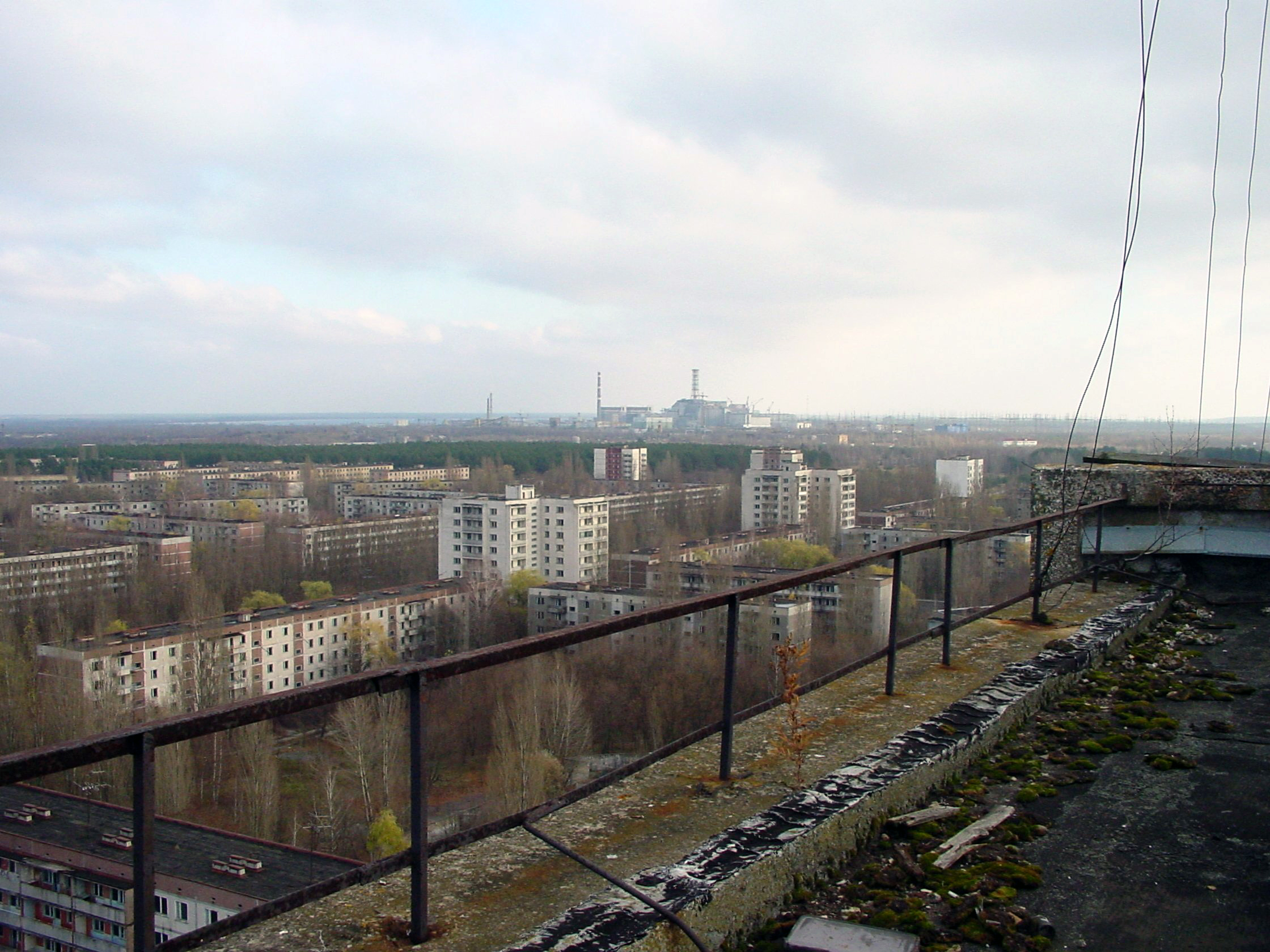
S.T.A.L.K.E.R. is a 2007 PC game by Ukrainian developer GSC Game World, that's loosely based on the novella Roadside Picnic by Arkady Strugatsky and the 1979 movie of the same name by Andrei Tarkovsky. The premise of the story revolves around the Zone, where a freak accident, this time based around the Ukrainian Nuclear Reactor explosion in Pripyat, has been the cause of paranormal activity and heavy mutations amongst the local fauna.
Unlike the movie, where the horror, if it can be called that, is purely psychological, the game contains some very real monsters among many irradiated dogs, huge mutated beasts reminiscent of the Fallout Maul Rats, and not the least a throng of human soldiers.
You're a Stalker and that's all you can remember as you wake up in an unfamiliar village somewhere in the Zone. The only clue to your past is a note in your PDA calling you to 'Kill Strelok!'. So you embark on a journey to find Strelok and find out why you should kill him if at all.
What makes the game great is the Fallout suspense and atmosphere, while the action is involving and laden with insecurity and the constant fear of running out of ammo, if you haven't stocked up for the scenario of a Third World War, what really shines about S.T.A.L.K.E.R. is how the Ukrainian studio has translated the feeling of the movie into an First Person Shooter form. The game starts out in a small town, with a bar and little else worth noting, but pretty soon you'll be crawling on all four through the sewers and bunkers and fields of Pripyat, running between concrete blocks for cover, from one quest to the next.
S.T.A.L.K.E.R. simulates the feeling of an open world game and although you won't feasibly be able to just walk around into the next area unequipped, each quest chain is set in its own large and expansive terrain, that's completely unique save for the ever present washed out Eastern European daylight, the dust and the ticking of your Geiger counter.
Besides being an FPS S.T.A.L.K.E.R. Shadow of Chernobyl possesses some RPG elements. You have a segmented chart-like inventory al-la Diablo, although it's limited by the amount of weight you can carry, rather than the trivial blocks of space you have. Nevertheless the sectioned grid gives you a rough idea of what each item weighs and pretty soon you'll find yourself balancing between carrying an extra weapon or some health packs, or stocking up on ammo for your trusty scoped Kalashnikov, that also happens to be maxed out on shooting speed. Best of all the weapons have grades and statistics, again much like Diablo. Rare weapons are spread throughout the game in tough to find or heavily protected areas, and they also may posses a special ability like extra damage, extra shooting speed, or stability etc. On top of that there's sets of armour, some provide trivial everyday Kevlar in-lay or even just some metal plates to hold them together, others are suited towards radiation-resistance. Both the weapons and armour suits in the game look futuristic and at the same time resemble completely technology that's readily available in the world today.
Among the few problems of the game, S.T.A.L.K.E.R. is a resource hog, and that's probably its biggest let-down. For a game of 2007 it could barely run on a mid-grade computer of that age and held it together just almost right on maxed out graphics on a high-end rig. But you shouldn't have these problems these days.
So now that prices for both the hardware and the games have dropped significantly, there's no reason why you shouldn't enjoy this particular game to its fullest. There's two expansion that came shortly after the original game - S.T.A.L.K.E.R. : Clear Sky and Call of Pripyat. The games are exciting, original, they're stuffed with content and they offer it in a compelling way. For a Fallout fan like myself there's nothing better than some post-apocalyptic lone-man journeying around the wasteland - be it my own beloved Eastern Europe.
Unlike the movie, where the horror, if it can be called that, is purely psychological, the game contains some very real monsters among many irradiated dogs, huge mutated beasts reminiscent of the Fallout Maul Rats, and not the least a throng of human soldiers.
You're a Stalker and that's all you can remember as you wake up in an unfamiliar village somewhere in the Zone. The only clue to your past is a note in your PDA calling you to 'Kill Strelok!'. So you embark on a journey to find Strelok and find out why you should kill him if at all.
What makes the game great is the Fallout suspense and atmosphere, while the action is involving and laden with insecurity and the constant fear of running out of ammo, if you haven't stocked up for the scenario of a Third World War, what really shines about S.T.A.L.K.E.R. is how the Ukrainian studio has translated the feeling of the movie into an First Person Shooter form. The game starts out in a small town, with a bar and little else worth noting, but pretty soon you'll be crawling on all four through the sewers and bunkers and fields of Pripyat, running between concrete blocks for cover, from one quest to the next.
S.T.A.L.K.E.R. simulates the feeling of an open world game and although you won't feasibly be able to just walk around into the next area unequipped, each quest chain is set in its own large and expansive terrain, that's completely unique save for the ever present washed out Eastern European daylight, the dust and the ticking of your Geiger counter.
Besides being an FPS S.T.A.L.K.E.R. Shadow of Chernobyl possesses some RPG elements. You have a segmented chart-like inventory al-la Diablo, although it's limited by the amount of weight you can carry, rather than the trivial blocks of space you have. Nevertheless the sectioned grid gives you a rough idea of what each item weighs and pretty soon you'll find yourself balancing between carrying an extra weapon or some health packs, or stocking up on ammo for your trusty scoped Kalashnikov, that also happens to be maxed out on shooting speed. Best of all the weapons have grades and statistics, again much like Diablo. Rare weapons are spread throughout the game in tough to find or heavily protected areas, and they also may posses a special ability like extra damage, extra shooting speed, or stability etc. On top of that there's sets of armour, some provide trivial everyday Kevlar in-lay or even just some metal plates to hold them together, others are suited towards radiation-resistance. Both the weapons and armour suits in the game look futuristic and at the same time resemble completely technology that's readily available in the world today.
Among the few problems of the game, S.T.A.L.K.E.R. is a resource hog, and that's probably its biggest let-down. For a game of 2007 it could barely run on a mid-grade computer of that age and held it together just almost right on maxed out graphics on a high-end rig. But you shouldn't have these problems these days.
So now that prices for both the hardware and the games have dropped significantly, there's no reason why you shouldn't enjoy this particular game to its fullest. There's two expansion that came shortly after the original game - S.T.A.L.K.E.R. : Clear Sky and Call of Pripyat. The games are exciting, original, they're stuffed with content and they offer it in a compelling way. For a Fallout fan like myself there's nothing better than some post-apocalyptic lone-man journeying around the wasteland - be it my own beloved Eastern Europe.
Also Check Out: Yesterday's Movie Feature: A Scanner Darkly and my previous Review of Stalker 1979 by Andrei Tarkovsky.